Which language model for which job
In plain words: Use a big clever helper only for the hard puzzles, a quick cheap one for the easy chores, and one that lives in your own house when the secrets must not leave it. AI, explained simply
In short
- "Which AI model should we use?" usually gets answered with a leaderboard. The better question is which job, because every big provider now sells a ladder of models for different jobs, and the price gap between the top and bottom rung is about a hundred times.
- I sort them into four kinds: frontier, workhorse, small and fast, and open-weight (models whose files you can download and run on your own machines). A fifth group, specialists, covers voice, transcription, images and gated models for security testing or life sciences.
- My rule: start with the workhorse, write a test from real examples of the job, then try one size down. Only move up when the test fails.
- For security, the question is less which model and more where the prompts go, who can change the model under you, and what the model is allowed to do.
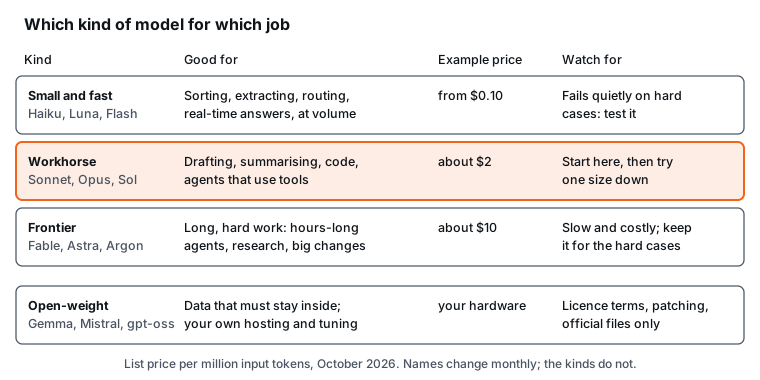
The four kinds
Model names in October 2026 are a blur of new numbers and code names (Anthropic's Fable, Opus, Sonnet and Haiku; OpenAI's Astra, Sol, Terra and Luna; Google's Argon and Flash), and most of them were released in the last two months. The names will be different by spring. The kinds will not.
Frontier. The most capable model each provider sells, for work that is long, hard and expensive to get wrong: an agent that runs for hours, multistep research, a large change to a codebase, analysis carried through to a finished document. OpenAI describes GPT-6 Astra as built "for complex end-to-end work such as reasoning, coding, computer use, and research". Anthropic suggests Claude Fable 5.1 for "agent sessions that run for hours" and multistep deep research. Google calls Gemini 4 Argon its model "to solve the hardest problems with depth and precision". These are slower and cost the most: Fable 5.1 lists at $10 per million input tokens.
Workhorse. One rung down, and where most real work belongs: drafting, summarising, code generation, data analysis, agents that use tools. Anthropic's own guide says "most workloads start with Claude Opus 5.5" and offers Sonnet 5.5 as "the best combination of speed and intelligence" at $2 per million input tokens. OpenAI positions GPT-6.1 Sol as a lower-cost option than Astra "for complex coding and professional work".
Small and fast. For volume and speed: classifying, extracting fields, routing a request to the right place, answering in real time, or acting as one of many helpers inside a larger agent. Anthropic lists Claude Haiku 5.5 for "classification, extraction, and routing" from $0.10 per million input tokens, a hundredth of the frontier price. OpenAI's Luna is the "lower-cost option" of its GPT-6 pair, and Google has its Flash and Flash-Lite models.
Open-weight. Models published as files you can download, run on your own hardware or a cloud of your choice, and tune. The good ones in 2026 include Google's Gemma 4 (Apache 2.0, from edge devices to 31B parameters), Mistral's Large 3 and the smaller Ministral 3 (Apache 2.0), OpenAI's gpt-oss, and large models from Chinese labs such as DeepSeek, Alibaba's Qwen and Moonshot's Kimi. Their appeal is control: Google says Gemma 4 allows "local, private execution that doesn't rely on cloud-only infrastructure". Their cost is that you run, patch and monitor them, and the best of them trail the best closed models by a few months (Epoch AI's estimate, as reported, is about four).
How I would choose
- Name the job, not the model. "Sort inbound complaints into twelve queues" and "review a contract against our playbook" are different jobs, and they do not need the same model.
- Write the test first. Fifty real examples with the answers you expect is enough to start. Without it, every model choice is a matter of taste.
- Start with the workhorse, then try one size down. If the small model passes, take the saving. Move up to frontier only when the workhorse fails the test, and then only for that job.
- Turn the effort dial before changing models. Most current models let you set how long they think. Google's advice for Argon is to "run your evaluations at all three levels, then pick the lowest level that meets your quality bar". Anthropic says "tuning effort is often a better lever than switching models".
- Route. Larger systems use more than one model: a small one triages, a workhorse does the bulk, a frontier model takes the hard cases. That is how a hundredfold price gap turns into a sensible bill.
Where security comes in
Where the prompts go. With a hosted model, prompts and uploads leave your network for the provider, often through a cloud platform you already use. That is the same question as any third-party service: contract, region, retention, whether your data trains their models. With an open-weight model you host, nothing leaves, whoever trained it. That is the main reason to choose one.
Open weights are not open source. You get the model, not the data it was trained on or a way to rebuild it. Licences vary: several flagship open models now carry custom terms with revenue or user thresholds, so read the licence of the exact version you deploy. A downloaded model is software from a third party. OWASP lists supply chain as the third of its top ten risks for applications built on language models; take model files from the publisher's official source, in a format that cannot run code when loaded.
Names change under you. An alias such as "latest" can point at a new model tomorrow. For anything that matters, pin the version, and re-run your test before moving to the next one. Write your policy about kinds ("hosted workhorse models in an approved region may see internal data") rather than names, or it will be out of date in a month.
The model is the smaller risk. A frontier model with no tools can only say something wrong. A small model wired to your email and file shares can do something wrong. What a model is allowed to reach matters more than how clever it is; OWASP calls this "excessive agency", and it is the subject of Agents are the new insiders.
Two examples
An insurer reading claims post. Thousands of letters a day need sorting into queues and the claim number pulled out. A small model, run hosted in the insurer's chosen region, with a test set from last month's post. A workhorse drafts replies for a handler to approve. Nobody needs the frontier model here.
A hospital summarising clinical letters. The letters cannot leave the hospital's own systems. An open-weight model of workhorse size, hosted on the hospital's own infrastructure, with its version pinned and a clinician-checked test set. The trade is more operating work for data that stays put.
What to do on Monday
- List the jobs you use language models for today, and which model each uses.
- Write a small test for each job from real examples.
- Try each job one size down, and turn down the effort before moving up.
- Write your AI policy about kinds of model and where data goes, not about product names.
- Pin model versions for anything that matters, and treat downloaded weights as third-party software.
Sources
- Anthropic, Models overview and Choosing a model (vendor documentation, read 27 October 2026).
- OpenAI, API changelog (GPT-6 Astra, 3 September 2026; GPT-6 Sol and Luna, 22 September; GPT-6.1 Sol, 29 September) and Announcing GPT-6 Sol and GPT-6 Luna (September 2026).
- Google, Using the latest Gemini models (vendor documentation, read 27 October 2026) and Gemma 4: Expanding the Gemmaverse with Apache 2.0 (April 2026).
- Mistral AI, Introducing Mistral 3 (December 2025).
- Slash Digital, Open-weight models 2026 (September 2026; secondary source for licence terms and the Epoch AI estimate).
- OWASP, Top 10 for LLM Applications 2025.
- Earlier on this topic: Agents are the new insiders, with API keys
- Later on this topic: Jev, the model that only decides: where it fits in security work
Personal work and my own view, not my employer's. Sources are public.