Jev, the model that only decides: where it fits in security work
In plain words: Jev is a very fast sorting machine that reads a message and picks an answer from a list you give it, but it cannot explain itself, so people still check the unclear ones. AI, explained simply
In short
- Jev, from the San Francisco start-up TypeSafe AI, opened to early users on 15 September 2026. It is not a chatbot. You give it some text and one or more questions, and it returns structured answers: which option, what score, how likely yes.
- It is fast (TypeSafe quotes 70 to 500 milliseconds) and cheap: one review measured about 4 cents per million input tokens, with output free. TypeSafe claims 40 to 400 times cheaper than frontier models on comparable tasks; that figure is its own.
- In security it fits where there is a lot to sort and a person or a bigger model can pick up the unclear cases: triage, data labelling, checks on what an AI agent is about to do, and choosing which model to call. It should prepare decisions, not make them.
What it is
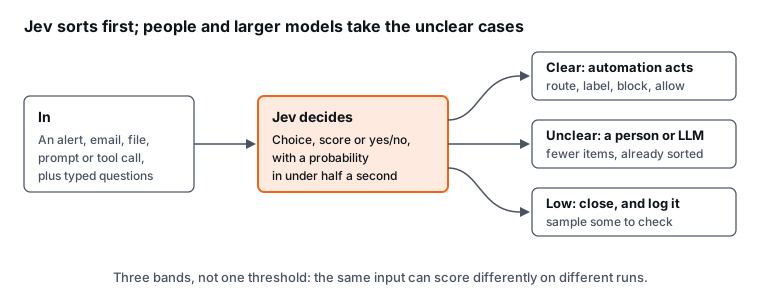
Large language models answer in prose, which software then has to parse. Jev answers in three typed forms only: a choice from options you list (with a probability for each), a score on a scale you define, and a yes/no probability for a statement. All the questions about one piece of text are answered in a single pass. Because there is no text to generate, there is nothing to ramble or invent beyond the options given.
TypeSafe has not published the architecture or a technical paper. It describes a transformer trained on synthetic data and tuned for calibrated decisions. The name is a nod to the economist William Stanley Jevons: the company expects that much cheaper decisions will mean many more places where software makes them. Copies and rivals followed within weeks, among them OpenAI Decisions, Microsoft Decision-1 and several open-weight models that run locally.
Where it fits
1. Triage at volume. User-reported phishing, SIEM alerts, vulnerability tickets, access requests: each can be asked "which queue?", "how urgent, 1 to 5?" and "does this mention a payment change?" in one call. One tester sorted 1,000 emails against seven rules in about six seconds for 9 cents. Clear cases go straight to automation; anything in the middle band goes to a person, who now sees fewer and better-sorted items.
2. Suggesting data labels. Data protection depends on knowing what a document or message contains, and asking people to label everything has never worked well. A classifier can propose a sensitivity label on each email, file or prompt, and policy can act on the confident ones. The DLP Framework Explorer sets out where labels sit among the other controls. One catch: Jev today is a US-hosted service, so sending your most sensitive text to it for labelling is itself a data transfer. For that data, a local open-weight model may be the better choice.
3. A check before an agent acts. Agent frameworks now use a fast classifier to look at each tool call before it runs: "is this command destructive?", "does it send data outside?". LangChain's integration does exactly this for shell commands. It fits the idea in governing AI agents: keep agents on short leashes, and put a cheap gate in front of the risky actions.
4. Choosing the model. The same integration uses Jev as a router: read the request, pick the cheapest model that can do it. That saves money, and it also gives security one place to send anything sensitive to an approved model only.
5. Screening prompts and content. Is this prompt pasting customer data? Is this inbound document trying to give instructions to the agent that reads it? A classifier is a quick first filter. It is not a defence on its own: attacker-written text is exactly what it reads, and one comparison found scores shifted when a misleading "reviewer" comment was added to the input.
Where it does not
- Final decisions about people. Hiring, dismissal, fraud accusations, refusing someone service. inovex's review advises against using it for recruitment under the EU AI Act, and it gives no reasons a person could challenge.
- Counting, dates and rules. Reviewers found it weak at numbers, dates, double negatives and multi-step reasoning. Keep thresholds and firm rules in code, and use the model only to pull facts out of free text.
- Anything that needs an explanation. It returns a probability, not a reason. An auditor asking why a case was closed needs more than 0.68.
- Single sharp thresholds. In one test the same ticket scored between 0.67 and 0.76 across 20 identical runs, and reversing the order of the options moved scores by about 0.1. A cut-off at 0.7 would approve and reject the same request on different days. Related questions are also answered separately and can contradict each other.
How I would start
- Pick one high-volume, low-stakes sort that people already do, such as phishing reports.
- Build a test set of a few hundred real, labelled cases and run it through two or three of the decision models, including a local one. Published comparisons put the leaders within two points of each other, so your own data decides.
- Use three bands, not one threshold: act automatically above a high score, send to a person in the middle, drop or close below a low one. Review the bands monthly.
- Log the model version, the questions, the scores and the outcome for every decision, so a change in the model shows up as a change in the numbers.
- Check where the text goes before sending anything sensitive.
Cheap decisions will multiply, as the name suggests. My own view is that this is useful when each one is small, reversible and logged, and risky when nobody is counting how many decisions now run without a person.
Sources
- Wikipedia, Jev (AI model)).
- inovex, TypeSafe AI Jev review: how good is the new model for AI classification? (29 September 2026).
- LangChain, Building a harness with Jev (17 September 2026).
- MindStudio, 12 Jev use cases tested.
- Fabio Akita, Which Jev-like AI decision/classifier model is best? (10 October 2026).
- Earlier on this topic: Which language model for which job
- Later on this topic: The AI supply chain: models, plugins and tool servers as third parties
Personal work and my own view, not my employer's. Sources are public.