Post-quantum migration starts with a cryptography inventory
In plain words: Future computers may break today's locks, so first find every lock you have, which is much harder than it sounds. Architecture and strategy, explained simply
In short
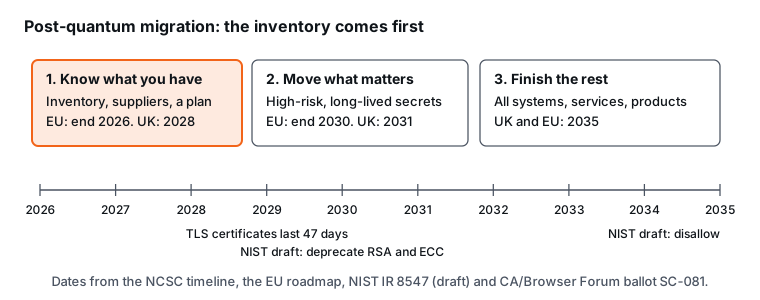
- The post-quantum algorithms are finished standards, and governments have put dates on the move: the UK's NCSC wants discovery and a plan by 2028 and migration complete by 2035; the EU wants inventories started by the end of 2026.
- Every one of those plans starts the same way: find out where cryptography is used, what protects what, and who controls it. That is the slow part.
- An inventory is not a one-off spreadsheet. Built well, it is what lets an organisation change algorithms, keys and certificates quickly, which it will need long before a quantum computer arrives.
Why there is a deadline at all
Most of the public-key cryptography in use today, RSA and elliptic curves, would be broken by a large enough quantum computer. Nobody can say when one will exist, but two things make the date less important than it sounds. Data copied today can be decrypted later, so anything that must stay secret for ten years or more is already exposed to a future machine. And replacing cryptography across a large estate has always taken years.
The replacements exist. In August 2024 NIST published its first three post-quantum standards: ML-KEM for setting up keys (FIPS 203), and ML-DSA and SLH-DSA for signatures (FIPS 204 and 205). NIST's advice at the time was to "start integrating them into their systems immediately". Its draft transition plan, NIST IR 8547, proposes deprecating today's quantum-vulnerable algorithms in 2030 and disallowing them after 2035.
Other governments have set similar dates. The NCSC's migration timeline, published in March 2025, asks organisations to define their goals, carry out discovery and build a plan by 2028; to finish the highest-priority migrations by 2031; and to complete migration "of all your systems, services and products" by 2035. The EU's coordinated roadmap from June 2025 asks member states to start cryptographic inventories and map dependencies by the end of 2026, to protect high-risk uses by the end of 2030, and to cover as much as possible by 2035.
Why the inventory is the hard part
Cryptography is not a product you can count. It sits in TLS on websites and APIs, in VPNs, in the certificates that devices and services use to prove who they are, in code signing, in database and disk encryption, in hardware security modules, in smart cards and tokens, and inside libraries that applications pull in without anyone choosing an algorithm. A good share of it belongs to suppliers: cloud services, SaaS, payment terminals, medical devices, building controls.
The NCSC is clear that this is not meant to be a formal asset register. What it asks for is an understanding of the estate: the key services, the data each holds and how long it stays valuable to an attacker, how that data is protected in transit and at rest, and the dependencies, including managed service providers. For the services an organisation runs itself, it asks for a more detailed map of cryptographic components, worked both top down from the business services and bottom up from what is actually on the wire and in the code.
That double approach matters. Top down tells you what matters most: the long-lived secrets, the signing keys that devices will trust for fifteen years, the systems that would hurt most if their traffic were read later. Bottom up tells you what is really there, which is usually more than anyone expected: old libraries, hard-coded algorithms, certificates nobody remembers issuing.
What the inventory is for
Ask what will use the inventory before building it. My own view is that it has three jobs.
- Ranking. Which systems protect data with a long secrecy life, or carry trust anchors that are hard to replace, such as firmware signing keys or device roots of trust? Those go first, because the 2031 milestone is about them.
- Supplier questions. A large share of the change will arrive in vendor releases. The CISA, NSA and NIST quantum-readiness factsheet of 2023 already put "engaging vendors" next to inventories and roadmaps. Knowing which suppliers hold which pieces turns a vague letter into specific questions with dates.
- Agility. The aim is to be able to change an algorithm, a key length or a certificate without a project each time. That need is not hypothetical: under the CA/Browser Forum's ballot SC-081, the longest a public TLS certificate may last falls in steps: from 398 days to 200 days in March 2026, 100 days in March 2027 and 47 days in March 2029. An organisation that can renew every certificate automatically, and knows where each one lives, has done much of the groundwork for post-quantum migration as well.
This is why I would rather treat the inventory as a live record fed by scanning, certificate management and software composition analysis than as a consultant's report. A list compiled once in 2027 will be wrong by 2029.
What to do on Monday
- Name an owner for cryptography across the organisation, if there is none. Often nobody owns it end to end.
- Pick the five business services that matter most and, for each, write down what data it protects, for how long that data must stay secret, and which keys and certificates it relies on.
- Find out how many certificates you have and how they are renewed. The 47-day schedule will force the question anyway.
- Add one post-quantum question to supplier reviews: which algorithms you use now, and when you will support ML-KEM and ML-DSA.
The Ascent of Security Architecture on the home page describes later stages as ones that sense and adapt. An estate that cannot change its own cryptography quickly will find those stages hard to reach, whatever else it runs.
Sources
- NIST, NIST Releases First 3 Finalized Post-Quantum Encryption Standards (13 August 2024).
- NIST, IR 8547 (initial public draft): Transition to Post-Quantum Cryptography Standards (12 November 2024).
- NCSC, Timelines for migration to post-quantum cryptography (20 March 2025).
- EU NIS Cooperation Group, A Coordinated Implementation Roadmap for the Transition to Post-Quantum Cryptography (June 2025), with a summary by PQShield.
- CISA, NSA and NIST, Quantum-Readiness: Migration to Post-Quantum Cryptography (August 2023).
- CA/Browser Forum, Ballot SC-081v3: Introduce Schedule of Reducing Validity and Data Reuse Periods (April 2025).
Personal work and my own view, not my employer's. Sources are public.