Is an AI agent just another non-human identity?
In plain words: Whether an AI helper counts as its own kind of account depends on one thing: does it carry a badge of its own, or borrow yours? Identity and access, explained simply
In short
- Most directories hold three kinds of identity: people, non-human identities (service accounts, keys, certificates, workloads) and a newer thing, the AI agent that acts for someone.
- My answer to "is an agent just another non-human identity?" is only sometimes. An agent is a way of using identities, not a kind of identity. What counts is whose credential it presents when it acts.
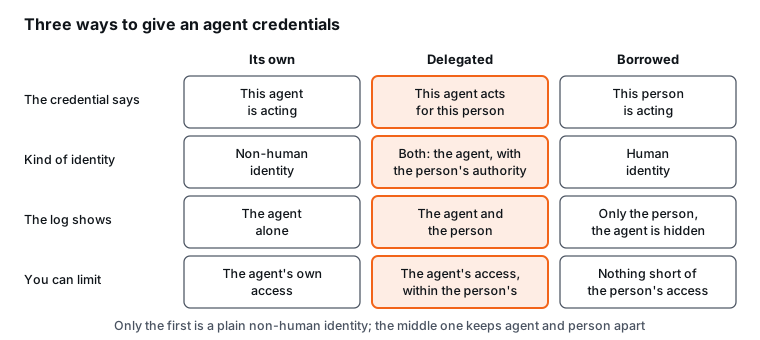
- There are three routes: credentials of its own, authority delegated from a person, or a person's login borrowed outright. Only the first is a plain non-human identity, and only the first two keep the agent visible in the logs.
- The route also decides whether your identity governance, access reviews and privileged access controls can see the agent at all.
Three kinds, side by side
Human. One person, who joins, moves and leaves, signs in interactively and answers for what they do. Most identity processes were built around this one.
Non-human, in the classic sense. Software acting as itself. The code is fixed, so the behaviour is predictable: a backup job backs things up. The risk sits in the credential, as I wrote in machine identities outnumber people: static secrets, no owner, too much access, never rotated.
Agentic. Software that decides what to do. Given a goal, it picks tools, calls services and may start other agents, usually for a person or a team. The word describes the behaviour. It does not say which credential the agent is holding.
Which credential does the agent present?
1. Its own. The agent is issued a service account, key or workload identity, and acts as itself. This is a non-human identity at the credential layer, with every old problem attached: an owner, an expiry, the least access that works.
2. Delegated. The agent exchanges a person's authority for a token that names both. OAuth token exchange (RFC 8693) separates impersonation, where the agent becomes the user and is indistinguishable from them, from delegation, where the agent keeps its own identity and the token records who it acts for. This is neither a plain human nor a plain non-human identity. It is the agent, carrying the person's authority. Microsoft's Entra Agent ID, for example, has separate Conditional Access templates for agents acting alone and for agents acting on behalf of users.
3. Borrowed. The agent runs with a person's own login, session or personal token. The credential is a human one, and the log says the person did it. The Cloud Security Alliance's June 2026 research note recommends separating agent identities from human ones, starting with the agents that run under human credentials. (The note describes itself as AI-assisted and not formally reviewed, so I treat it as a view, not as evidence.)
In 2025 Apurva Davé of Aembit gave the same split in different words in a Cloud Security Alliance article: a non-human identity for an agent that runs on its own across sessions, a human one for an agent acting for a particular person, and "it depends" in between. He also argued that agents deserve a third category of their own.
What the classic definition misses
Even in the first route, "non-human identity" describes the credential and not the behaviour. Agents add three things that a service account never did:
- The behaviour is not fixed. A service account is safe in proportion to how narrow its code is. An agent's actions come from a model reading text, including text from emails, web pages and tickets that outsiders can write. The CSA note puts it as "not the identity itself but the behavior bound to it."
- It acts for someone. The question grows from "who is this?" to "who sent it, what did they allow, and through which chain of hand-offs?" The OpenID Foundation's October 2025 whitepaper says current frameworks "weren't designed for recursive delegation chains", where agents start sub-agents and pass authority along. An individual IETF draft from April 2026 (work in progress, one independent author) lists the same gaps: no durable link to the human, delegation left implicit, and agents copied with no record of lineage.
- It is created and grows at runtime. Agent frameworks can create identities on demand, and agents tend to keep the permissions they gathered for one task. The "no owner" problem from the earlier note arrives automatically.
What PAM, recertification and IGA make of it
These three programmes were built for people, and each rests on an assumption that agents quietly break.
IGA (identity governance and administration). IGA runs the life of an identity: created, changed, removed, with HR as the source of truth for people. An agent has no HR record, so a named owner has to be the anchor, as with any other non-human identity. Microsoft's Entra ID Governance now has sponsor workflows that reassign an agent when its sponsor changes roles or leaves, "to prevent orphaned agents". NIST's February 2026 concept paper on agent identity (a draft for comment, not guidance) points at the same machinery, suggesting SCIM to create, update and revoke agent identities across systems, and asking whether agent identity data should be ephemeral and tied to a task.
Recertification. The periodic review asks a manager to confirm that each entitlement is still needed. That suits a person with a stable role. It suits an agent badly: agents "tend to retain those permissions long after the task has ended", and a reviewer cannot tell from an entitlement name whether a model will need it next week. The CSA note's answer is usage-based reviews with no standing privilege, so the question becomes "what did it use, and for what?" The route matters here too. With a borrowed login, the manager certifies the person's access without knowing an agent exercises it. That is my own reading, not something the sources say. With delegation, the person's access caps the agent, but the agent's own access still needs a reviewer, and the sponsor is the natural one.
PAM (privileged access management). PAM vaults secrets, rotates them, grants elevation just in time and records sessions. All of that carries over to an agent with its own credentials, with a shift in emphasis: the CSA note recommends short-lived, task-scoped credentials and workload identity (SPIFFE or SPIRE) over vaulting static keys. Two questions are new. Privilege is about what an agent can do, so an agent that can run commands or call administration interfaces is privileged whatever its account is called, and NIST asks how to apply least privilege when an agent's actions "might not be fully predictable". And a "session" for an agent is a run of tool calls, so each action must trace to the agent's own identity record, which is what NIST's paper means by linking actions to "the identity of the non-human entity". On a borrowed login, a person's just-in-time elevation becomes the agent's elevation, and the PAM record names only the person. Again, that is my reading.
My view
Asking which box the agent belongs in is the wrong question. Ask which route it takes, and whether you can see the agent in the log. Routes one and two keep the agent distinguishable and can be limited, and delegation can also be capped by what the person is allowed to do. Route three loses both, and it also hides the agent from the governance tools: NIST's concept paper says access systems should "distinguish between agent and human identities", which a borrowed login defeats. That is why I would treat it as the one to remove first. For work with no person behind it, route one is the right fit, with all the discipline that non-human identities already need.
What to do on Monday
- For each agent in use, find out whose credential it presents when it acts.
- Move agents off borrowed logins, to delegation where a person is behind the task and to their own identity where not.
- Give every agent its own identity and a named human sponsor, and review the agent when the sponsor moves or leaves.
- Prefer delegation to impersonation, and ask suppliers whether their tokens record both the agent and the person.
- Put agents into identity governance with a sponsor, a purpose and a retirement step, and list them in your machine identity inventory, flagged as agents.
- Review agents by what they used, not by what they hold, and prefer short-lived, task-scoped credentials to vaulted static keys.
- Decide which agents count as privileged by what they can do, and give those the same controls as administrators.
Sources
- Cloud Security Alliance, Non-Human Identity Management for Agentic AI: Extending IAM Beyond Humans (research note, June 2026).
- Apurva Davé, What Kind of Identity Should Your AI Agent Have? (Cloud Security Alliance, June 2025).
- OpenID Foundation, Identity Management for Agentic AI (whitepaper, October 2025).
- IETF, Problem Statement for Human-Anchored Agent Identity, Delegation, and Provenance (individual Internet-Draft, April 2026).
- IETF, RFC 8693: OAuth 2.0 Token Exchange (2020).
- Microsoft, What's new in Microsoft Entra Agent ID (documentation, 2026).
- NIST NCCoE, Accelerating the Adoption of Software and AI Agent Identity and Authorization (concept paper, February 2026), and the NIST announcement.
- OWASP, Non-Human Identities Top 10, 2025 (2025).
- Earlier on this topic: Machine identities outnumber people; few organisations can list them
- Later on this topic: Identity is the perimeter, so what guards identity?
Personal work and my own view, not my employer's. Sources are public.